
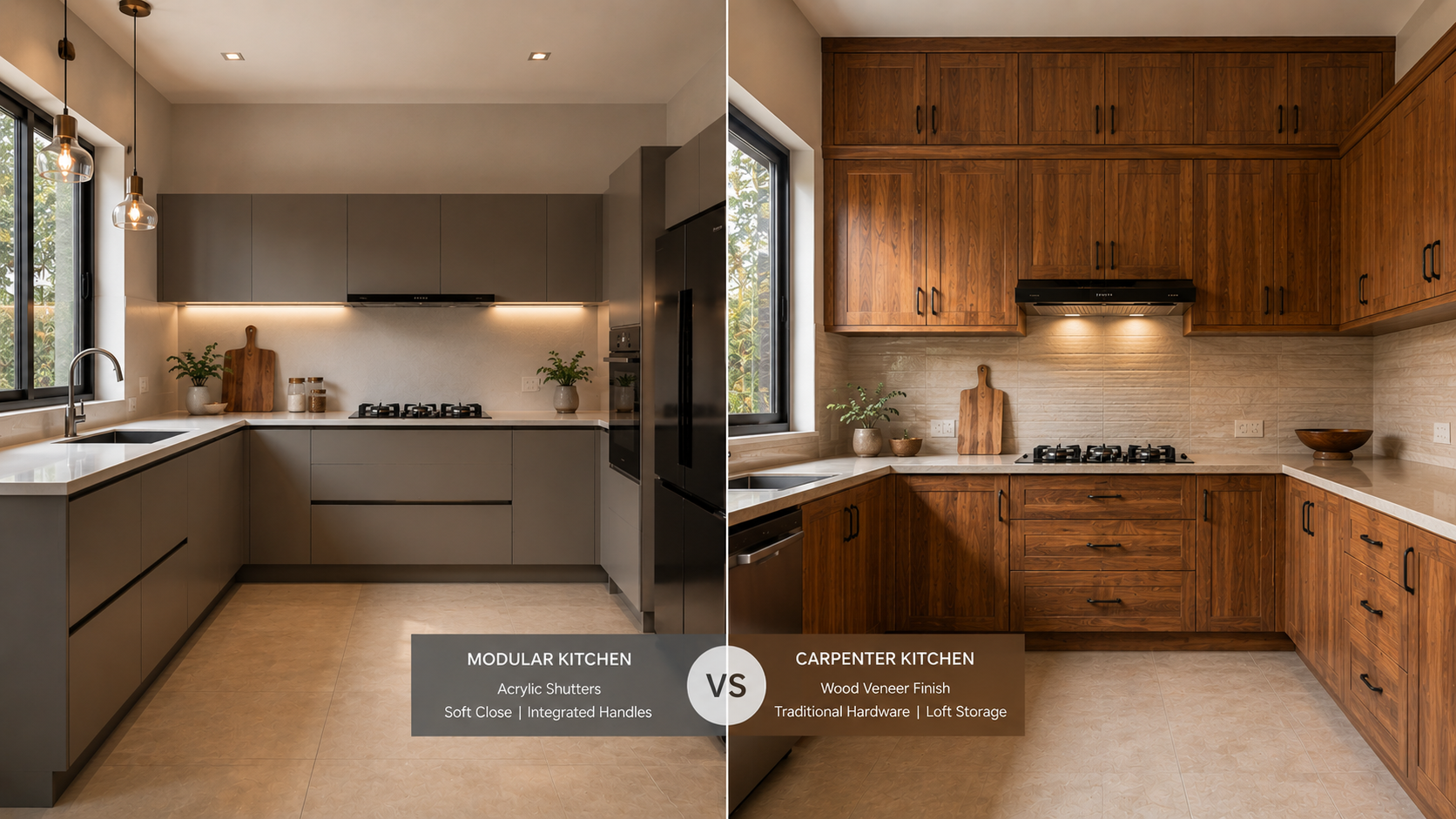
If you're comparing a modular kitchen vs carpenter made kitchen in Ahmedabad, the decision usually comes down to three things: budget, timeline, and how long you plan to live in the home. Both options can look identical from the outside. The differences show up in the hardware, the finish quality after five years, and how much you pay for either.
This guide breaks down the real differences so you can choose based on your home, not on what a salesperson tells you.
What Is a Modular Kitchen
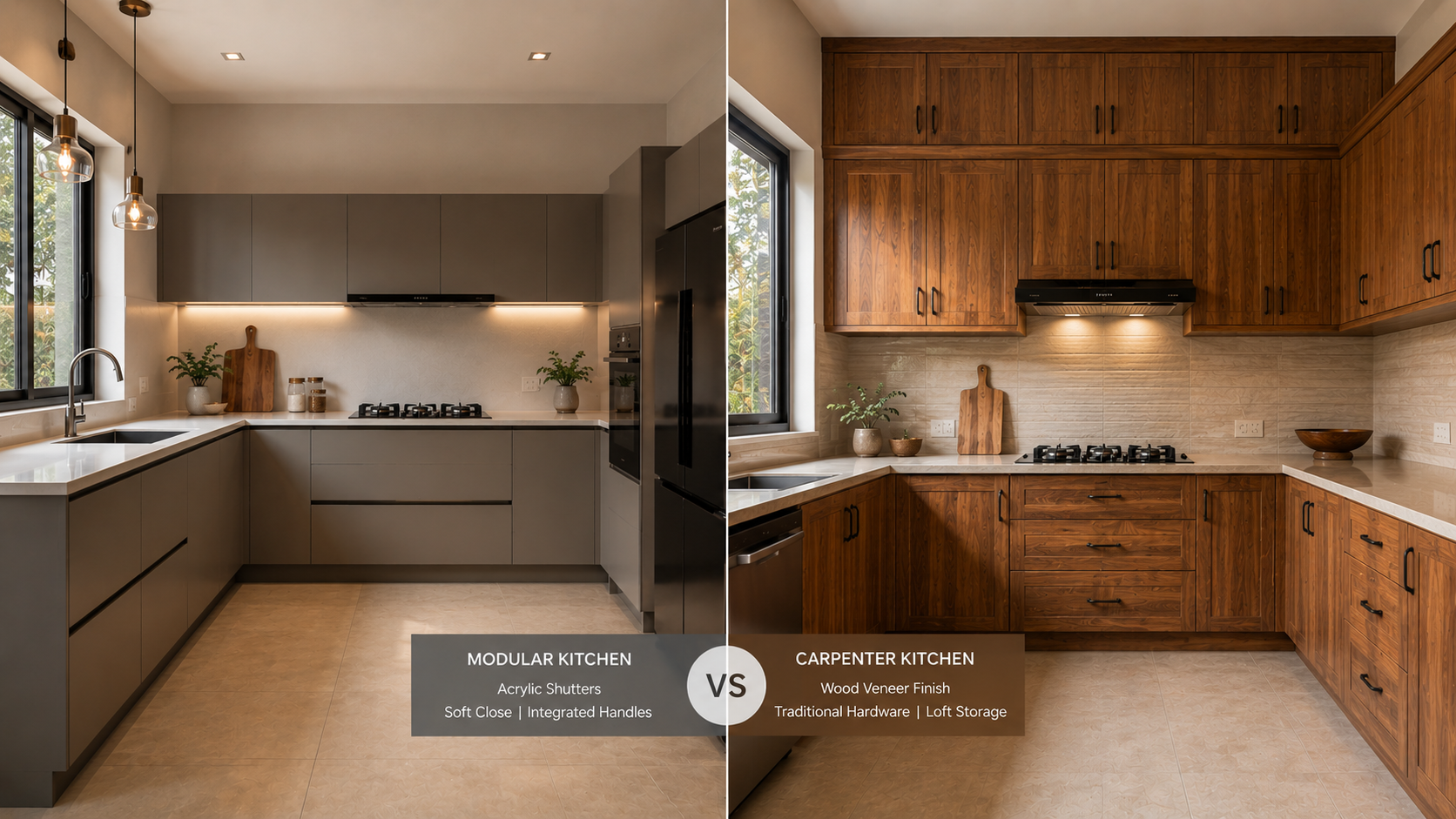
A modular kitchen is built from pre-manufactured cabinet units assembled on site. The carcass, shutters, and hardware are made in a factory under controlled conditions, then fitted together like a system. Standard modules come in fixed widths, so the layout is planned around these sizes rather than custom-cut for your exact wall.
What Is a Carpenter Made Kitchen
A carpenter made kitchen is built on site by a local carpenter using plywood, MDF, or solid wood, cut and assembled according to your specific dimensions. Every panel is custom to your kitchen. There's no factory involved. The carpenter measures, cuts, and fits everything by hand, often over several days at your home.
Modular Kitchen Cost vs Carpenter Made Kitchen Cost in Ahmedabad
Carpenter made kitchens are usually 15 to 25 percent cheaper upfront in Ahmedabad, mainly because labor costs are lower than factory manufacturing and finishing costs. A modular kitchen from a mid-range brand typically runs higher per running foot, but that price includes factory-grade finishes, soft-close hardware, and moisture-resistant boards as standard.
The gap narrows if your carpenter uses branded plywood and imported hardware. It widens if you go with an unbranded local carpenter using low-grade material to keep the quote attractive.
Durability and Finish Quality
This is where the two diverge the most. Modular kitchens use factory-pressed boards (usually BWP plywood, MDF, or particle board) with laminate or acrylic finishes applied under heat and pressure. This process seals the edges properly, which matters a lot in Ahmedabad's summer heat and humidity swings. Poorly sealed edges on carpenter made units tend to swell or peel within two to three years, especially near the sink and stove area.
Carpenter made kitchens depend entirely on the individual carpenter's skill and the quality of adhesive used on site. A skilled carpenter with good material can match modular quality. An average one, working without factory-grade pressing equipment, usually can't seal edges as tightly.
Best Material for Carpenter Made Kitchen in Ahmedabad
The material your carpenter uses matters more than the carpenter's skill in most cases. Three options come up most often in Ahmedabad.
BWP plywood (boiling water proof) handles moisture the best and is the safest choice for base cabinets under the sink and near the stove. It costs more than commercial plywood but resists swelling in Ahmedabad's humidity swings during monsoon.
MDF (medium-density fiberboard) gives a smoother surface for shutters and works well for wall units that don't face direct water exposure. It takes paint and laminate finishes cleanly but swells faster than BWP plywood if water sits on it.
Particle board is the cheapest option and shows up in budget quotes. It has the weakest moisture resistance of the three and isn't recommended for a kitchen in Ahmedabad given the seasonal humidity.
For a carpenter made kitchen, ask for BWP plywood on base units and MDF or plywood on wall units, with proper edge banding on every exposed cut. This single specification affects durability more than almost any other decision in the build.
Design Flexibility
Carpenter made kitchens win here. Since everything is custom-cut, odd-shaped kitchens, narrow galleys, or unusual ceiling heights get a tighter fit with zero wasted space. Modular kitchens work within standard module widths (300mm, 450mm, 600mm), so irregular layouts sometimes need filler panels that eat into usable space.
If your kitchen has a non-standard layout common in older Ahmedabad homes and bungalows, a carpenter made kitchen or a hybrid approach often fits better.
Modular Kitchen vs Carpenter Kitchen: Which Is Better for Small Kitchens
Small kitchens amplify the differences between the two approaches because every inch of storage counts.
Modular kitchens use systemized units built for compact spaces, including pull-out baskets, corner carousel units, and tall pantry units that maximize vertical storage. These components are engineered specifically for small footprints and come pre-tested for smooth operation.
A carpenter can build similar storage solutions, but the result depends on their design experience with compact layouts and access to the same hardware (soft-close hinges, telescopic channels, corner mechanisms) that modular brands source directly from manufacturers. Without that hardware, carpenter made storage in small kitchens tends to rely on simple shelves rather than space-maximizing mechanisms.
If your kitchen is under 60 square feet, a modular kitchen or a hybrid build (carpenter-built carcass with modular hardware) usually delivers more usable storage than a fully carpenter made kitchen.
Installation Timeline
Modular kitchens are faster to install since the units arrive pre-fabricated and just need assembly and fitting, usually 7 to 15 days depending on size. Carpenter made kitchens take longer because everything is built from scratch at your site, often stretching to 20 to 30 days, and your kitchen is unusable for cooking during most of that period.
Resale and Long-Term Value
Modular kitchens carry more weight during resale since buyers associate them with a "finished, modern home" look. Carpenter made kitchens can look just as good when built well, but the resale value depends heavily on how well the finish has held up, which ties back to the durability point above.
Which One Should You Choose
Go modular if you want consistent finish quality, faster installation, and you're planning to sell the home within 5 to 10 years. Go carpenter made if your kitchen has an irregular layout, you're on a tighter budget, and you plan to personally supervise quality on site. A growing number of Ahmedabad homeowners choose a hybrid: carpenter-built carcass with modular hardware and factory-finished shutters, which balances cost against durability.
Planning Your Entire Home Interior, Not Just the Kitchen?
A kitchen is one part of a bigger decision. If you're renovating or furnishing a full home in Ahmedabad, the same trade-offs (cost, material quality, and timeline) apply to every room. Neotecture designs complete residential interiors, from layout planning to execution, so every space in your home works together instead of being decided room by room in isolation.
FAQs: Modular Kitchen vs Carpenter Made Kitchen
Is a modular kitchen more expensive than a carpenter made kitchen in Ahmedabad?
Yes, typically. Modular kitchens cost 15 to 25 percent more upfront due to factory manufacturing, though the gap depends on the brand and material grade chosen for the carpenter made option.
Which lasts longer, modular or carpenter made kitchens?
Modular kitchens generally last longer due to factory-sealed edges and moisture-resistant boards. A carpenter made kitchen can match this if built with branded plywood and proper edge banding, but quality varies by carpenter.
Can a carpenter match modular kitchen quality?
A skilled carpenter using branded plywood, proper edge banding, and quality hardware can come close to modular finish quality, though factory pressing still gives a tighter seal on edges.
How long does a modular kitchen take to install in Ahmedabad?
Most modular kitchens take 7 to 15 days to install once the design is finalized and units are manufactured, compared to 20 to 30 days for a fully carpenter made kitchen.
What is the average cost of a modular kitchen in Ahmedabad?
A mid-range modular kitchen in Ahmedabad usually costs between Rs. 1,200 and Rs. 2,500 per square foot, depending on the brand, shutter finish, and hardware chosen. High-end acrylic or PU finishes push this higher.
What is the average cost of a carpenter made kitchen in Ahmedabad?
Carpenter made kitchens typically range from Rs. 900 to Rs. 1,800 per square foot in Ahmedabad, with the final price depending on the plywood grade, laminate quality, and hardware brand the carpenter sources.
Which material is better for kitchen cabinets, plywood or MDF?
Plywood handles moisture and load-bearing better, which makes it the stronger choice for base cabinets near the sink. MDF gives a smoother finish for shutters and works well for wall units away from direct water contact.
Do modular kitchens come with a warranty?
Most modular kitchen brands offer a warranty ranging from 1 to 10 years depending on the brand and component, covering hardware, shutters, and sometimes the carcass. Carpenter made kitchens rarely come with a formal warranty since the work isn't backed by a manufacturer.
Can I get a hybrid kitchen with both modular and carpenter made elements?
Yes, many Ahmedabad homeowners get the carcass built by a carpenter and the shutters, hardware, and finish supplied by a modular brand. This combines lower base cost with a factory-grade finish on the visible parts of the kitchen.
Is a modular kitchen worth it for a small kitchen?
Modular kitchens work well in small kitchens because the systemized units make better use of vertical space with pull-out units, corner solutions, and tall storage. A carpenter can replicate this, but it depends heavily on their design experience with compact layouts.
How do I maintain a carpenter made kitchen to make it last longer?
Wipe down surfaces immediately after spills, especially near the sink and stove, since unsealed edges absorb moisture faster than factory-finished ones. Reapply edge sealant every few years and avoid using abrasive cleaners on laminate or veneer finishes.
Which is better for resale value, modular or carpenter made kitchens?
Modular kitchens generally add more to resale value since buyers associate them with a move-in-ready, low-maintenance home. A well-maintained carpenter made kitchen with a good finish can still hold value, but it depends on visible wear at the time of sale.